Remembering Without Memory
Markus Werning
Ruhr-University Bochum, Germany
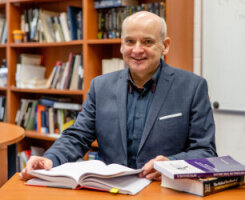
Already Aristotle, in De Memoria et Reminiscentia, distinguishes memory (mneme) from remembering (anamnesis). The verb "remember" refers to the instantaneous and typically conscious mental event with episodic representational content occurring when we recall a past scenario. The noun "memory", in contrast, denotes a representational but typically non-conscious mental state that perdures over time. In this paper, Werning argues that remembering goes without memory and still generates knowledge about scenarios experienced in the past. The reliable construction of a scenario of the past in remembering is due to an interaction of minimal, i.e. non-representational traces, and statistical regularities acquired over the lifetime.
📍 Daewoon Hall Annex 105, Yonsei University (Sinchon Campus), Seoul, South Korea